Forty engineers, and a filing cabinet of certificates
An engineer arriving at a site had no way to know what had happened there before. The history existed, in a cabinet, forty miles away.
- Client
- A building services contractor
- Sector
- Facilities management
- Duration
- 10 weeks
- Year
- 2026
Repeat callouts, 90 days
- Before
- ~1 in 6
- Now
- ~1 in 14
Paperwork returned
- Before
- 2 to 9 days
- Now
- Same visit
Certificates on site
- Before
- None
- Now
- All of them
Engineers per dispatcher
- Before
- ~12
- Now
- ~20
The problem
The contractor maintained catering, heating and refrigeration equipment for commercial sites across the north west, with about forty mobile engineers and ninety staff in total.
Job sheets were completed on paper and returned to the office between two and nine days later. Certificates were typed up at head office and filed there. An engineer standing in front of a piece of equipment had no way to find out what had been done to it before, so they diagnosed it again.
Dispatchers spent most of the day on the phone, because the phone was the only way to find out where anyone was.
What we found
We pulled a year of job sheets and matched them by asset rather than by site, which nobody had done, because on paper it would have taken weeks.
One reactive call in six was a repeat visit to equipment someone had already attended within ninety days. In a third of those, the same part had been replaced twice.
None of that information was missing. It was in a filing cabinet at head office, forty miles from the engineer who needed it.
How we got there
Ten weeks. The engineers had filled in the same paper sheet for years, and they were going to judge its replacement in the first minute of the first job.
No signal is the normal case
Plant rooms and basements have no reception, so we designed for that first. The job sheet is saved on the phone as it is written and sends itself when the engineer is back above ground. The office can see which write-ups are still waiting to send, so nobody rings to ask where the paperwork is.
A label the first time someone attends
The history only helps if the engineer finds the right boiler in it, and the equipment had no consistent numbering. Nobody was sent round to label everything. Each piece gets its label the first time an engineer attends it, and the year of old job sheets was matched to it at head office afterwards.
Almost no typing
The first job sheet asked for a typed description of the work, and engineers wrote two words. The one in use is mostly choices: the outcome, the part from a list, photographs, and a line of notes only when the job needs one. We tried it in a work glove before any engineer did.
The history the engineers asked for
The first version listed previous visits. The engineers wanted the parts: what had been fitted, when, and whether the same part had been fitted before. That became the panel at the top of every piece of equipment, and it is what they read in the van before getting out.
What we built
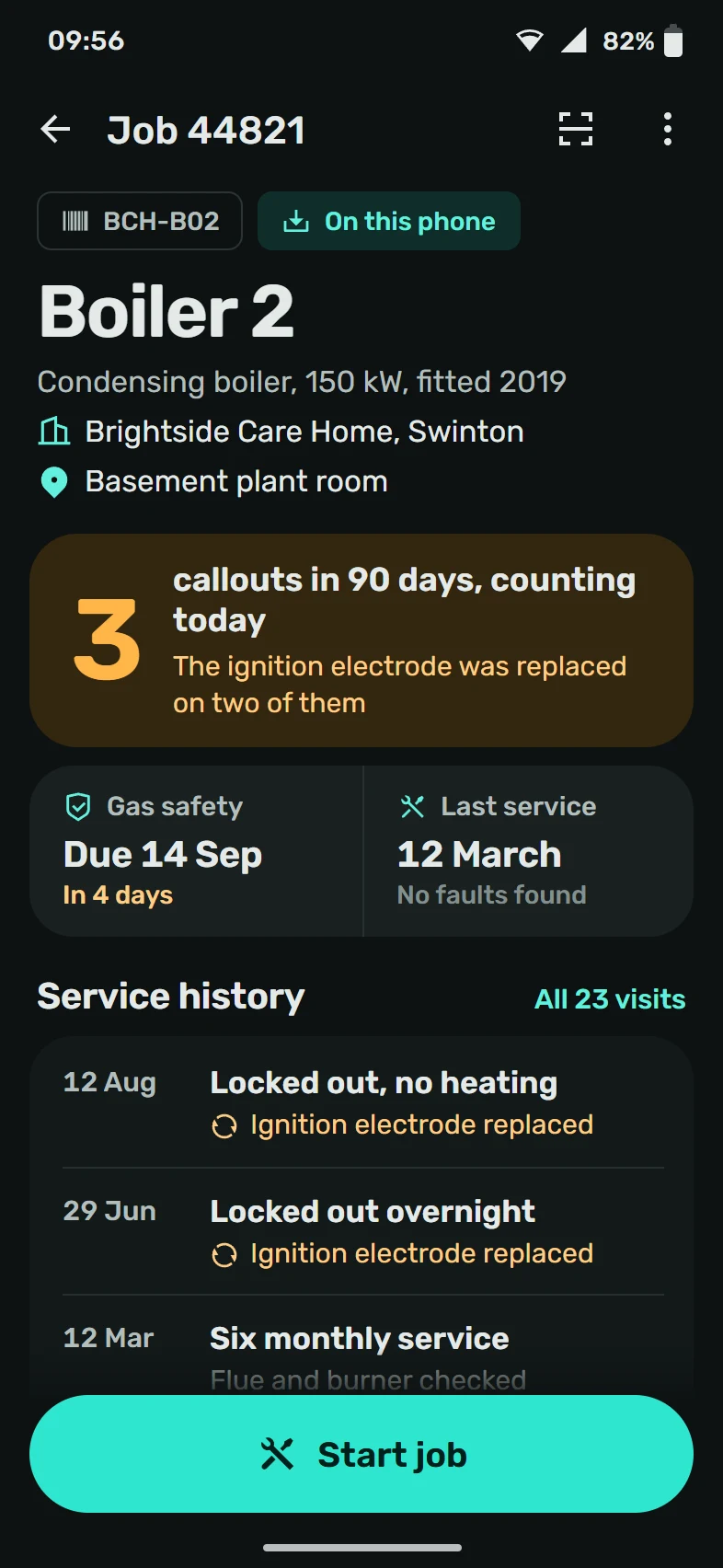
Asset history and certificates, on the phone
Every piece of equipment carries its full service record, its certificate dates and its previous faults. An engineer reads it in the van before getting out.
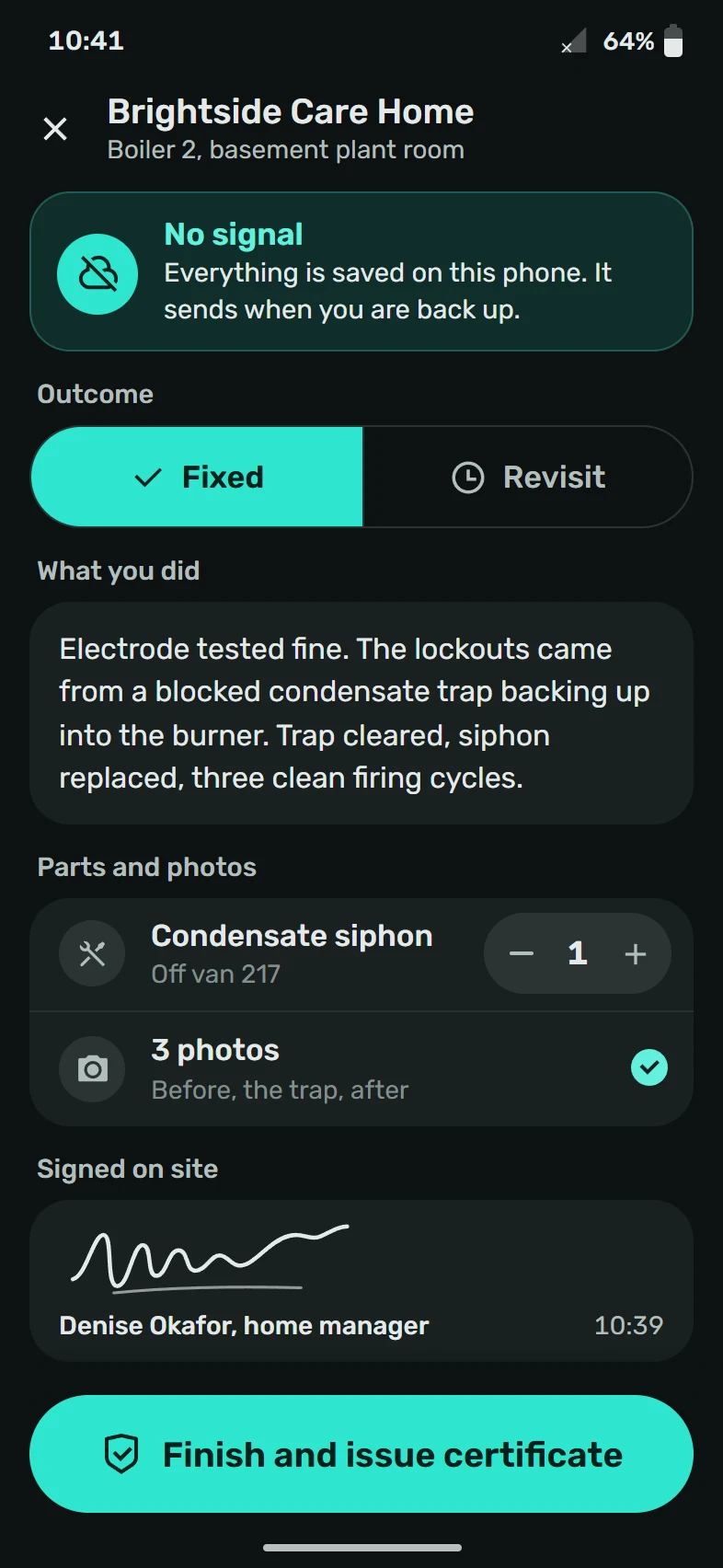
Job sheets that finish on site
Outcome, parts, photographs and a customer signature captured before the engineer leaves. The two to nine day paperwork gap closed to nothing.
Certificates issued at completion
Generated from the job record and sent to the customer the same visit, rather than typed up later by somebody who was not there.
Built to work without signal
Plant rooms and basements have no reception. The app holds the job, accepts the write-up offline and sends it when the engineer comes back up.
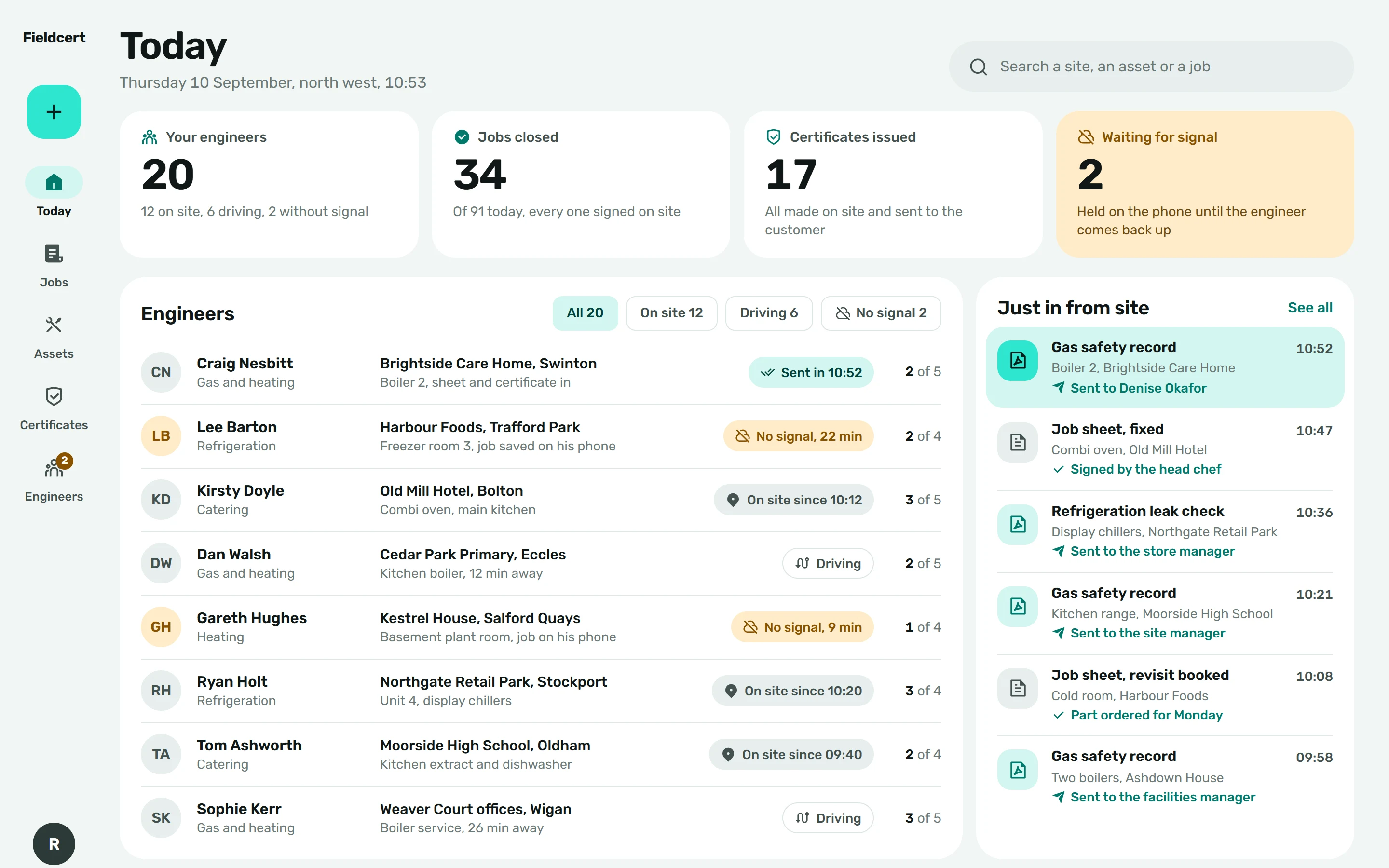
Afterwards
The dispatch board was the part management asked for. The asset history is the part the engineers asked us to extend, and it is the one that shows up in the repeat callout figure.
The contractor has since stopped filing paper certificates altogether, which was not part of the brief and took a change to their own retention policy.
Built with
- TypeScript
- React
- Progressive web app
- IndexedDB offline sync
- Service workers
- Node
- Fastify
- PostgreSQL
- PDF certificate generation
- Web Push
Services used
More case studies

Is this your problem too?
If any of the above sounded familiar, describe your version of it. The first conversation is about whether software is the right answer at all.
From £10,000Most projects land between £15,000 and £55,000.